2013 Subaru BRZ


Subaru BRZ is a rear-wheel drive sports car featuring the Horizontally-Opposed Boxer engine. It was developed as a joint-project between Subaru and Toyota Motor Corporation, to bring to the world a sports car with superior steering response and driving pleasure that everyone can experience. The Subaru Boxer engine in the BRZ was positioned even lower than other Subaru models so that the BRZ has one of the lowest possible centers of gravity s on the market today. This low center of gravity produces astonishing handling character and combined with a light-weight chassis BRZ realizes Subaru's aim for "Pure Handling Delight" -the driving experience taken to a new level.

Concept

The product concept of Subaru BRZ is "Pure Handling Delight." The Horizontally-Opposed Boxer engine has inherent qualities of low center of gravity, lightweight, and compactness. These attributes are maximized by placing this engine even lower and closer to the center of the chassis. These factors contributed to BRZ's low center of gravity -one of the lowest possible. The Subaru BRZ is a fun sports car that any driver can enjoy driving with peace of mind.

Design

The Subaru BRZ has a low-mounted Boxer engine on a specially designed sub-frame that forms an "ultra-low center of gravity package". With this arrangement, BRZ achieved a low driving position typical of a sports car. Overall height of Subaru BRZ is 1,300 mm and it has a wide and low body of a stylish coupe at 1775mm. Yet, it allows for 2+2 seating and a trunk with ample space. Not only is the BRZ a sports car, but it can also be a suitable partner for long tours with its unexpected utility.
2013 Subaru BRZ


Exterior

Subaru aimed for a sports car design that instinctively conveys the car's fun-to-drive character. In addition, it was detailed to be instantly recognizable as a Subaru.

Front fascia

The "ultra-low center of gravity package" also allowed a low hood design. This low hood and bulging front fenders raise expectations for the Subaru BRZ's drivability. Also, to communicate the Subaru identity the Subaru six-star ornament, headlights and hexagon lower grille follow the Subaru design motif common across new Subaru models.

Side

The low center of gravity enhances BRZ's sensuous beauty with its shapely fender flares. The aesthetic beauty is combined with functional beauty that advances aerodynamics through such areas as the C-pillar shape, rear glass inclination, trunk lid layout. As would be expected from a sports car, the front and rear overhangs were shortened to express the Subaru BRZ's liveliness. The front fender is accentuated with a distinctive garnish.

Rear fascia

The projecting rear wheel arches sit by way of contrast to the compact cabin and emphasizes the beauty of the BRZ's rear view.

Interior

Details were carefully designed to allow a new level of fun-to-drive experience in which the driver and vehicle become one.

The steering wheel was made smaller to achieve sports car maneuverability.

A tachometer with digitally displayed speedometer is placed in the center of the gauges so that the driver can instantly see information without diverting attention from the road.

Bespoke sports car seats were designed to hold the driver and passenger and feature lowered sitting positions to match the "ultra-low center of gravity package".

Engine

Making full use of the design concept of the new-generation Boxer engine, the newly developed engine made exclusively for the BRZ is highly efficient with superior output and environmental friendliness. It realizes an exhilarating high revving nature of a naturally aspirated sports engine.

It has square bore and stroke of 86 x 86 mm.

Due to the joint development with Toyota Motor Corporation, Toyota's direct injection and port injection technology "D-4S" was incorporated in the Subaru BRZ's power unit.

To achieve the "ultra-low center of gravity package", the engine as a whole has been made more compact by such means as adopting the shorter intake manifold and the shallower oil pan.

Transmission

The joy of sports car driving was realized through a transmission that focuses on shift feel and response.

The 6-speed MT employs a short stroke shift lever. The lever was optimized in rigidity, shift quality and weight application in its pursuit of a superb shift feel.

The 6-speed AT has "S mode" for better shifting response and "M mode" for optional shifting. Also, with the paddle shift and downshifting blipping control, this model can respond faithfully to the driver's inputs.

Body

The lightweight yet highly-rigid body was developed exclusively to maximize the advantages of the "ultra-low center of gravity package".

Low center of gravity and low driving position were achieved by the perimeter type body frame layout.

The body has a rigid and durable frame structure that also works in balance with the vehicle's light-weight. The rigidity is optimized for high drivability and appropriate durability is maintained for collision safety.

High tensile steel was used in the body to contribute to weight reduction. Effective use of this material in the upper structure of the Subaru BRZ contributed to its low center of gravity.

The front hood employs aluminum for lightness. The structure was fine-tuned for a low styling that also improves pedestrian protection performance.

Chassis

Excellent maneuverability and stability of the "ultra-low center of gravity package" offers direct and sharp response to steering and enhances driver's connection to the car

The front suspension employs struts for light-weight and high rigidity, while a double wishbone layout is adopted at the rear for better shock absorption.

To gain a low front hood from the "ultra-low center of gravity package", the front strut mount was lowered while maintaining the stroke.

The tires are 215/45R17 combined with lightweight and highly rigid aluminum wheels.

All models are equipped with electronic stability control to provide both driving pleasure and safety.

2011 Subaru BRZ STI Concept


Subaru of America, Inc. reveals an all-new concept version of its upcoming BRZ sports car at the 2011 Los Angeles International Auto Show. The Subaru BRZ STI Concept represents the next step in lightweight performance sports cars combined with the race-bred refinements of STI, a performance brand of Subaru.

The first BRZ concept car to be shown with bodywork, the Subaru BRZ STI Concept strongly hints at the styling of the production BRZ and features unique STI performance features.

Styling

Sleek, low and tightly-coiled bodywork blends with STI performance touches for a sporting profile. A hexagonal lower front grille, hawk eye headlights and fin-shaped fog lamps are instantly recognizable as Subaru. The exterior color "WR Blue Pearl II" is a new generation of the iconic WR blue paint scheme that has adorned both racing and production STI's.

The body is set-off with aero-tuned lower front spoiler, unique rear fascia and a rear wing for added down-force. A carbon-fiber roof has been added to lower the center of gravity (CoG), which will be

one of the lowest of any car made. The rear design features bold rear fender flares and large rear-diffuser giving way to polished stainless-steel quad-tailpipes. Vented rear bumper corners contribute to improved aerodynamics performance.

Engine

The concept car employs the totally new Subaru "FA" BOXER™ engine exclusively designed for the RWD BRZ sports car. In order to achieve properties best-suited for the BRZ sports car, the overall structure of this 2.0-liter naturally-aspirated four-cylinder boxer engine has been designed with a square bore and stroke of 86 X 86 mm. The inherent qualities of the Subaru BOXER engine were mated to a direct injection fuel system, which further improves combustion efficiency, running smoothness up to high rpm and high environmental standards.

Chassis

The lightened Subaru BRZ STI Concept features an STI-tuned suspension, Brembo™ brakes and unique 18-inch wheels and tires. The Subaru-engineered and built chassis boasts a rigid frame housing a two-plus-two interior and front engine/rear-wheel drive layout. With the engine mounted low and rearward in the engine compartment near-perfect balance is achieved.

The Subaru BRZ STI Concept is designed to combine lightweight, a low polar moment and razor-sharp reflexes for the ultimate handling machine. The low engine placement also allows for a very low and blade-like hood design. Short front and rear overhangs reduce the yaw moment of inertia.

Compared with other Subaru models, which already feature a low center of gravity and optimal weight distribution, the engine in the Subaru BRZ STI Concept sits even lower. It is 4.7 inches lower and is positioned 9.4 inches closer to the center of the chassis compared to a Subaru Impreza.

The first RWD Subaru, the production Subaru BRZ will begin production in spring 2012 as the only mass-produced front-engine, BOXER engine rear-wheel drive sports car in the world.

2011 Subaru Advanced Tourer Concept


Exquisitely balancing the enjoyment of driving with environmental friendliness Subaru Advanced Tourer Concept, under its product concept of 'Revolutionary Sports Tourer', embodies Subaru's theme of 'Confidence in Motion'.

This C-segment class car was developed as a new-generation sports wagon providing both superior driving performance and utility. It features an innovative exterior design not found in conventional wagon models and expert wagon utility Subaru has cultivated over the years. The well established sports power unit, the Horizontally-Opposed Subaru Boxer engine, is now with direct fuel injection. This highlight mixed with Subaru's downsizing concept and original Hybrid Electric Vehicle (HEV) expertise has enabled Subaru to make considerable progress on its unique Symmetrical All-Wheel Drive (AWD) technology. An even sportier driveability and advanced environmental friendliness are both attainable in this new concept car.

Exterior Design

Subaru's brand statement 'Confidence in Motion' is portrayed in the outward design as well. The dynamic yet sleek look promises an enthusiastic drive, while the cabin offers all the usability of a C-segment wagon. A flowing line on the side surfaces augments the stylish design calling to mind a coupe style car.

Interior Design

In pursuit of Subaru's human-centered philosophy, all passengers are assured a safe and pleasant ride in a comfortable and quality interior.
2011 Subaru Advanced Tourer Concept


An entire roof made of glass adds to the spacious feel. Various textures such as wood and metal are incorporated into the inside layout to produce ample ambiance.

A large monitor is built into the steering wheel allowing access to maps, television and internet services. Information will be available at hand to support contemporary lifestyles even in the car.

Downsized direct fuel injection turbo engine

The downsized direct fuel injection turbo engine is one of the principal technologies that will guide Subaru's engine strategy in the future. Not only is acceleration quick and smooth with the new-generation Horizontally-Opposed engine, it is environmentally friendly. The direct fuel injection system which injects necessary amounts of fuel into the cylinders at appropriate moments, and a turbo system which efficiently supplies large amounts of air into the cylinders, along with the downsizing of current turbo engine displacements (2,500cc and 2,000cc) to 1,600cc drastically improve combustion efficiency at practical driving-speed range compared to the existing turbo engine.

High torque compatible Lineartronic (CVT)

Lineartronic is Subaru's continuously variable transmission device designed for the new era. It is the world's first longitudinally-mounted chain drive CVT to be utilized in mass-produced AWD passenger cars. For the concept car, the Lineartronic was refined to satisfy the high-power output turbo engine.

Hybrid system

Subaru' s original hybrid system has been developed to harmonize with the Symmetrical AWD technology, another one of its specialties, and to further enhance its appeal. A single motor system was employed for its simple structure and light weight.

This system has an Electric Vehicle (EV) mode which allows AWD motion using only the motor at start-ups and low-speed drives. When decelerating, the regenerating mechanism uses the motor as a power generator.

EyeSight

Subaru's advanced driving assist system EyeSight (Version 2), well received since its release in May 2010, has made further progress. The recognition range of the stereo camera has expanded considerably, both in width and depth.

Specifications
Length x Width x Height: 4,580mm x 1,840mm x 1,430mm
Engine type: 1.6 liter Horizontally-Opposed direct fuel injection turbo engine
Transmission type: High torque compatible Lineartronic
Drive train: Symmetrical All-Wheel Drive with hybrid system
Battery type: Lithium-ion battery

2011 Subaru Forester


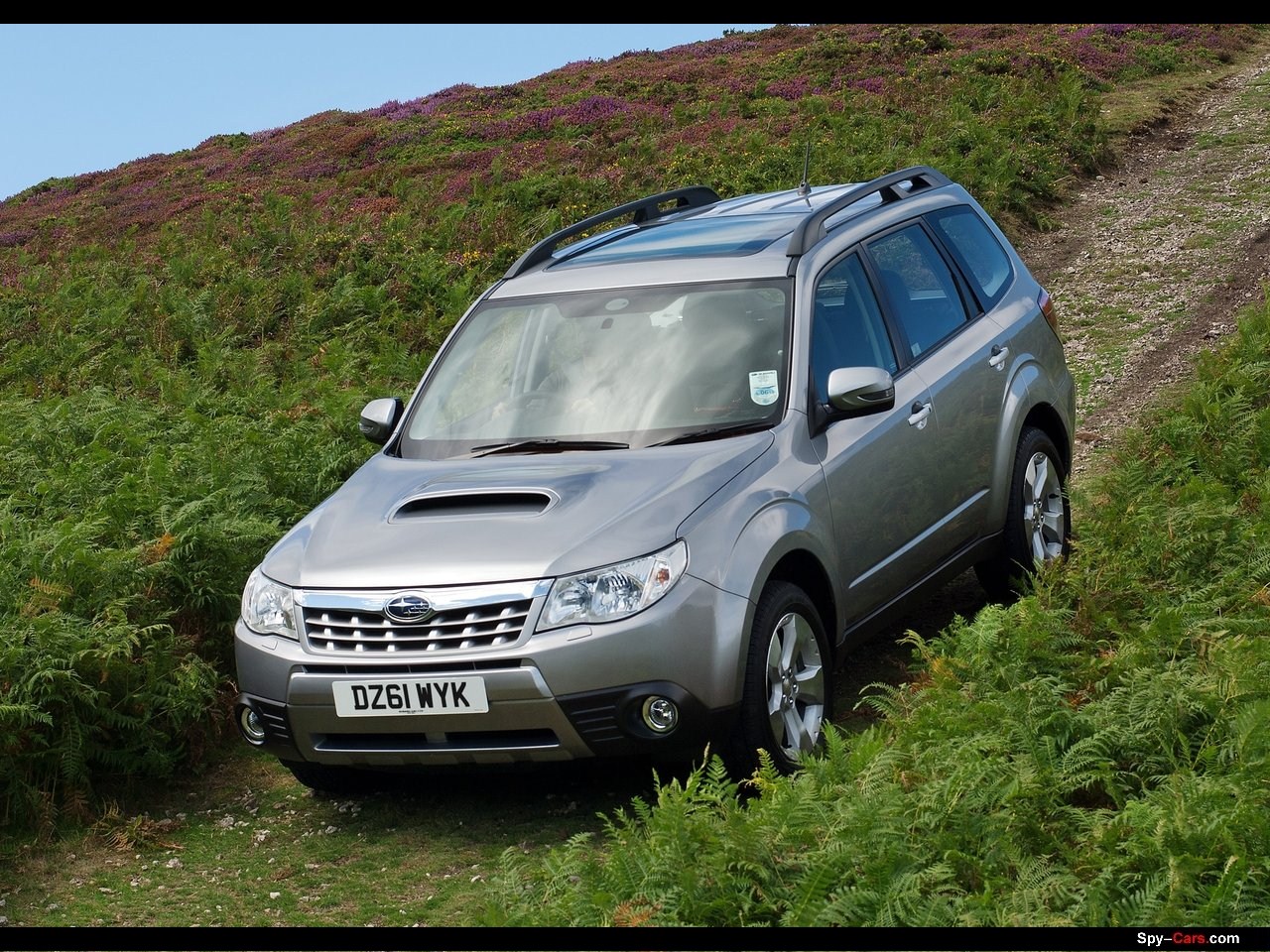
The 2011 Forester is Subaru's third generation of crossover SUV. Based on the Impreza platform, the Subaru Forester features a multi-link rear suspension, fuel-saving electric power steering and Subaru Vehicle Dynamics Control.

All Forester vehicles feature Subaru's Symmetrical All-Wheel Drive system, and customers can choose the new-for-summer-2011 2.0-litre Boxer petrol engine - returning 37.7mpg (combined) and a low CO2 emission figure of 173g/km - or the new, even more frugal Boxer diesel engine (47.9mpg, combined) which also offers an impressive between-fills range of 625 miles (1,000km).

Boasting exceptional agility, improved fuel economy, impressive load space and car-like characteristics, the Subaru Forester SUV is great value, priced from just £21,370 (OTR).

EQUIPMENT AND DESIGN

The Subaru Forester boasts a clean, chiselled appearance with multi-grooved wheel-arches, hawk-eye headlamps and muscular bumpers. Thought has even been given to the chunky exterior door handles, which have deep recesses to allow winter glove-wearers an easier grip.

The instruments have a sporty appearance thanks to their clear design and subtle lighting while the extensive vehicle information display includes an instantaneous fuel consumption indicator, highlighting the Subaru Forester's excellent efficiency.

Other premium touches shared by all Foresters include a gas strut-assisted bonnet, flowing fascia design, double-stitched seat cloth, metallic interior decoration, padded armrest cushions and a premium audio system that includes USB, iPod and Bluetooth connectivity.
2011 Subaru Forester


The diesel Subaru Forester offers outstanding equipment levels with even the base Forester 2.0D X featuring Symmetrical All-Wheel Drive, Subaru Vehicle Dynamics Control, self-levelling rear suspension, fuel-saving electric power steering, front, side and curtain airbags and 16 x 6.5-inch alloy wheels with 215 / 65 tyres.

Other features include electric windows fore and aft, 60/40-split rear seats with reclining back-rests, climate control air-conditioning, radio/CD player, front fog lamps, vehicle information display, height and reach-adjustment steering wheel, leather-covered steering wheel, handbrake and gearlever, heated front seats, mirrors and windscreen wipers and cruise control.

The Subaru Forester 2.0D XC adds roof-rails, larger, 17 x 7.0inch alloy wheels with 225 / 55 tyres, electrically folding door mirrors, one-touch folding rear seats, HID headlamps, a large, electrically-powered sun-roof and a premium audio system featuring a built-in rear reversing camera and a large display screen for ease-of-use

Topping the diesel range, the Forester 2.0D XS NavPlus, adds satellite navigation with single disc DVD / CD / radio, leather seats, electrically powered driver's seat and keyless Smart-entry with push-button start.

The petrol Subaru Forester line-up starts with the entry-level Forester 2.0 X. It features Symmetrical All-Wheel Drive, Subaru Vehicle Dynamics Control, self-levelling rear suspension, fuel-saving electric power steering, front, side and curtain airbags, four electric windows, 60 / 40-split rear seats with reclining back-rests, climate-control air-conditioning, radio / CD player, front fog lamps, vehicle information display, height and reach-adjustment steering wheel, heated front seats, mirrors and windscreen wipers plus cruise-control and 16-inch alloy wheels. Manual models feature a dual-range transmission.

Finally, the higher-spec Forester 2.0 XS petrol offers 17-inch alloy wheels; leather seats, steering wheel, gear-lever and handbrake; premium audio system featuring a built-in rear reversing camera and a large display screen for ease-of-use; HID headlamps; sun-roof, electrically powered driver's seat; electrically folding door mirrors; retractable rear seat tray with cup-holder; engine starter button and keyless 'smart' entry.

NEW BOXER DIESEL IN DETAIL

Dedicated to the horizontally opposed Boxer engine layout for over 40 years, Subaru engineers were determined to use this proven format for their first diesel engine and for the new, improved version of this powerplant introduced in spring 2011.

The desire was to create a light, compact, strong unit with reduced vibration, noise and internal friction, as well as an ultra-low centre of gravity, compared to an in-line engine. This configuration enhances handling agility and road holding - especially when combined with Subaru's renowned Symmetrical All-Wheel Drive system.

The diesel engine and transmission are not only mounted very low down but also within the vehicle's wheelbase, which further boosts chassis dynamics. The horizontally opposed pistons effectively cancel out any secondary harmonic vibration (vibration with twice the frequency of the engine speed). The crankshaft is short and highly rigid, minimising the vibration noise often present in many other diesel engines.

And the superior balance of the horizontally opposed engine means internal rotational inertia and friction are drastically reduced compared with an in-line engine. Reduced internal friction means throttle response is also exceptionally lively and in keeping with Subaru's sporty heritage.

The cylinder block is of a rigid semi-closed deck design, while all five main bearings in the alloy block use metal composite supports for added strength and durability. It also enhances refinement, providing a similar thermal expansion to that of the crankshaft.

A special surface treatment to withstand the diesel engine's high combustion pressures is applied to the high-strength crankshaft, while the uprated cylinder heads have roller rocker arms. In addition, the cam-drive is via a chain system that is better able to handle the variations in torque of the diesel engine.

The new version of the Boxer diesel employs an advanced common-rail fuel-injection system with the fuel highly pressurised before being fed into the common rail. This maximises efficiency, both in terms of power, fuel consumption and emissions.

The development of the revised diesel engine focuses on nine key improvements. These include enhanced turbo-charger efficiency with reduced pumping losses, new exhaust-camshaft timing, increased EGR cooling, optimised flow-rate in the cooling circuit, fitting 4 per cent lighter connecting rods, eliminating the mini-PTC heater and switching to a smaller capacity 150-A alternator.

The new Boxer diesel meets Euro5 emission standards thanks to oxidation catalytic converters and a DPF (diesel particulate filter). This minimises particulate matter - the cause of black smoke.

Performance is improved while fuel economy and emissions are significantly improved. Maximum power is still 147ps at an ultra-low 3,600rpm and the substantial 350Nm (258lb.ft) of torque is now even more accessible, from 1,600 to 2,400rpm - 200rpm lower than previously.

Diesel Subaru Forester's top speed and 0-60mph figure are among the best in the compact SUV class. Top speed is 115.5mph and the sprint to 60mph is dispatched in 10.3 seconds. Even more importantly, in-gear flexibility leaves most competitors trailing thanks to strong mid-range torque and the carefully chosen ratios of the new six-speed manual gearbox.

Fuel economy in the Subaru Forester 2.0D X is improved by an average of 7.2 per cent, to an outstanding 39.8 (urban), 54.3 (extra urban) and 47.9mpg (combined). The Forester 2.0D XC and XS NavPlus derivatives, with their wider tyres, are not far behind at 39.2 (urban), 53.3 (extra urban) and 47.1mpg (combined). The new CO2 emission figures are especially impressive, down from 167 and 170g/km, respectively to just 155 and 158g/km.

To maximise the benefits of this new-found frugality, the Boxer diesel's fuel tank is larger - 64 litres compared to the petrol model's 60 litres, giving it a range of 625miles / 1,000km.

2.0-LITRE PETROL IN DETAIL

The latest Subaru Boxer petrol engine delivers improved environmental credentials compared to its predecessor, while also affording smooth acceleration. The new FB-A engine (found in the 2.0 X and XS Forester models) offers stronger low and mid-range pulling power, enhanced flexibility and improved fuel economy, as well as lower exhaust emissions.

The 2.0-litre four-cam configuration remains the same, featuring twin overhead camshafts per bank (DOHC), four valves per cylinder and an Active Valve Control System (AVCS) - a form of variable valve timing. The stroke has been increased by an additional 8mm to 92mm, offering an improvement in torque in the low- and mid-speed ranges, in addition to reduced emissions. Capacity is now 1,995cc.

The cylinder head, cylinder block and valve train have been re-designed, while the intake and exhaust systems have been extensively re-worked to optimise efficiency through increased air flow. Modifications to the cooling system channels now allow the engine to reach operating temperature quicker, with faster increases in oil temperature, reducing friction and improving fuel economy.

For this third-generation Boxer petrol engine, Subaru also employs a chain-type camshaft drive, as found on Subaru's six-cylinder engines and the brand's Boxer diesel engines. A more compact design and maintenance-free setup are two important benefits of this alteration.

Urban / extra urban / combined fuel consumption figures are now 29.1 / 44.8 / 37.7mpg for the Subaru Forester 2.0 X and XS automatic models, with an improved CO2 figure of 174g/km. This compares favourably with the petrol automatic competition.

The four-speed automatic achieves the 0-60mph dash in 12.3 seconds, with a maximum speed of 115mph, while improved torque allows higher gearing for improved refinement and economy, with no sacrifice in engine response.

Manual versions of the Forester show similar improvements with urban / extra urban / combined figures of 30.1 / 44.1 / 37.7mpg, and a low CO2 rating of 173g/km. Top speed for the manual Subaru Forester is 114mph with a 0-60mph time of 10.6 seconds.

TRANSMISSION

The Forester diesel boasts a six-speed manual gearbox with optimised ratios for quiet, refined high-speed cruising and flexible low-speed manoeuvres. For example, sixth gear is slightly higher than fifth on the Legacy and Outback boxer diesels, with a ratio of 0.557:1, delivering 31.5mph / 1,000rpm for the Subaru Forester 2.0D X, while first gear is lower at 3.454:1.

The six-speed manual gearbox employs a cable change. Apart from giving a consistent feel, cables isolate transmission and engine vibration, enhancing refinement.

Petrol models are also available with a four-speed automatic transmission. This provides smoother changes with greater sensitivity to the driver's wishes. It is more efficient, saving fuel, because a slip lock-up device reduces wasted engine revs. In addition, advanced electronics - linked to an electronic throttle - match engine speed with the best gear for any given situation.

A new feature is 'Sports Shift' which allows drivers to select from 'normal', 'sports' or 'manual' modes, allowing them to 'tap-shift' between the gears at will.

As with previous models, the full-time All-Wheel-Drive transmission features a 60 / 40 Active Torque-Split on the automatic. However, the split varies according to changing road surface and weather conditions.

SYMMETRICAL ALL-WHEEL-DRIVE

All Forester models enjoy the benefits of Subaru's acclaimed full-time Symmetrical All-Wheel-Drive system, as well as Subaru Vehicle Dynamics Control, as standard. The latter system uses sophisticated sensors to detect side-to-side and front-to- rear slip, plus sudden steering movements. It controls oversteer / understeer and potential loss of control by braking individual wheels and cutting engine revs - all in a matter of milliseconds.

The Subaru Forester's quick-thinking full-time Symmetrical AWD system splits power 50 / 50 per cent front / rear as its default setting. However, as soon as slip is detected, the centre differential with its viscous-coupling distributes torque to the axle with the most grip.

RIDE AND HANDLING

A sophisticated Symmetrical All-Wheel-Drive system, low-friction, long-travel four-wheel independent suspension and low-centre-of-gravity Boxer engine, all contribute to the Subaru Forester's reputation for outstanding chassis dynamics.

It offers a highly absorbent ride with precise geometry control for accurate straight-line running over uneven road surfaces backed by extremely responsive steering and handling.

The rear multi-link, double-wishbone suspension liberates more luggage space thanks to its compactness compared to the previous rear-strut arrangement. And because it is attached to a sub-frame via bushes, with the mounting section moved to under the floor itself, road noise is reduced, too.

To boost ride comfort, the rear springs and shock-absorbers are mounted behind the centre-line of the rear wheels, with the wheel stroke itself moving rearwards. A rear anti-roll bar is standard.

Like all previous Subaru Forester incarnations, the rear suspension features self-levelling which aids stability when laden and ensures a constant ground clearance - now a substantial 215mm - 10mm greater than before.

At the front, the previous sub-frame has been eliminated, saving 20kg in weight. However, a new box-section for the front cross-member provides the same level of structural rigidity.

The MacPherson strut suspension and anti-roll bar layout is based on that used by the highly acclaimed Legacy and Impreza. It offers high lateral rigidity which improves steering response and cornering stability.

This is further enhanced by an especially rigid mounting for the steering rack and the positioning of the steering gearbox and electric motor below the rack for a more consistent feel. Furthermore, special suspension bushes and attachment points reduce road shock.

A more linear feel to the steering has been achieved, while the steering gear ratio has been changed for a sportier feel and the rack diameter is increased from 23 to 26mm.

For the Boxer diesel Subaru Forester, the front damping has been firmed up together with the steering to sharpen handling and compensate for the 45kg increase in engine weight.

Wheel and tyre sizes have been optimised for the new Subaru Forester's chassis and anticipated all-terrain use.

The Subaru Forester X models feature 16 x 6.5-inch alloy wheels with 215/65 R 16 tyres, while Forester XC, XS and XS NavPlus have 17 x 7.0-inch alloy wheels with 225/55 R 17 tyres.

PASSENGER AND PEDESTRIAN PROTECTION

Both occupants and pedestrians are well protected by the Subaru Forester thanks to a whole series of safety measures aimed at achieving the highest standards.

Curtain and side airbags are now fitted to all models together with driver and front passenger dual-stage airbags. The front seatbelts have pre-tensioners, anti-whiplash front head restraints are standard and the front seats have energy-absorbing backs.

The brake pedal is energy-absorbing, being designed to snap away under severe impact, protecting the driver's lower limbs. In the rear seat, two ISOFIX-compatible child seat mountings are fitted.

Also fitted as standard, the anti-lock braking system (ABS) comes with electronic brakeforce distribution (EBD). This system juggles the braking force between front and rear wheels according to weight transfer during deceleration. Unlike the previous model, the new Forester has ventilated front disc brakes.

High-tensile steel is used extensively throughout the bodyshell, providing good 'crushability' where needed for protecting the passenger area. Not only does the elimination of the previous Subaru Forester's front sub-frame reduce weight by 20kg, but the new structure better dissipates front impact forces.

Pedestrian protection is also greatly enhanced. Because the Subaru Forester is higher than a car, more space has been made between the bonnet and catch, while the bonnet itself has been designed to spread impact load over its entire surface. The back of the bonnet compresses easily and the cowl ahead of the windscreen is designed to dissipate collision energy.

A shock-absorbing plate has been installed ahead of the front bumper beam to reduce pedestrian leg injuries. This design meets European pedestrian safety regulations while retaining the Subaru Forester's off-road approach angle, as expected of an SUV.

WARRANTY

All Foresters come with the reassurance of a three-year or 60,000-mile warranty plus 12-year anti-corrosion cover and three-year paintwork warranty.

This is in addition to three years membership of Subaru Assistance - a comprehensive home and roadside repair and recovery package throughout the UK and Europe, administered by Mondial Assistance.

Service intervals are 12,000 miles or one year - whichever arrives first.

Insurance ratings are also extremely competitive at Group 9E for the Subaru Forester 2.0D X and XC and Group 10E for the Subaru Forester 2.0D XS NavPlus.

2012 Subaru XV


The Subaru XV is a new type of crossover SUV that not only projects a great presence despite its compact sporty design, but also boasts a range of new features never seen before in an SUV. While the proportions of the Subaru XV convey a sense of elegance and lightness, its exterior design combines high ground clearance, large tire wheels, and all of the other features one would normally expect to find in an SUV. What's more, superior drive performance and fuel efficiency made possible by Subaru next-generation power unit are joined here with the excellent maneuverability for which Subaru is renowned and an extremely high level of functionality. Thanks to the symmetrical All-Wheel-Drive and advanced Subaru Dynamic Chassis Control Concept - two core Subaru technologies - this vehicle feels incredibly safe and secure to drive. And as such, the new XV adds unique Subaru value to the ever-growing C-segment crossover market. Not only have Subaru made it possible to truly provide "safety and pleasure" as defined in our new brand statement, "Confidence in Motion," but in this new strategic model, it has been realized a unique Subaru persona—a persona that Subaru fully intends to further enhance going forward. Subaru is confident that the Subaru XV will thoroughly satisfy the needs of a diverse range of customers.

The fundamental product concept that Subaru adopted for the Subaru XV can be expressed in two simple words - "Urban Adventure." In specific terms, a vehicle that would be perfectly suited to exciting, lively use in a city landscape. Thus, Subaru strove to optimally balance enhanced basic performance factors in the form of fuel efficiency and enjoyable driving (Fun to Drive) with a stylish, highly distinctive exterior design. As the Subaru crossover family continues to grow, the stylish Subaru XV is unique in the way it can be both sporty and casual. To this end, it boasts five key strengths.
Sleek but muscular - Smart, powerful design: Subaru has given the Subaru XV a highly distinctive design that blends a uniquely Subaru profile with a sporty, energetic overall presence.
Achieving both nimble drive and environmental friendliness: Notwithstanding its overall height, the Subaru XV feels extremely secure to drive, and thanks to a new engine and transmission that work hand in hand to make it more environmentally friendly, this SUV delivers a highly reliable ride that is uniquely Subaru.
Safety performance of the highest standard: In addition to providing the driver with an excellent field of view, Subaru has applied our considerable expertise in the fields of collision avoidance performance and passenger protection performance.
Spacious, relaxing cabin: the Subaru XV features an extremely roomy passenger compartment, a cargo area that is both spacious and convenient, and excellent riding comfort.
Performance and equipment suited to urban life: Not only is this SUV remarkably easy to get in and out of, but it boasts an advanced, highly convenient information/entertainment system that supports the driver in a great many ways.
2012 Subaru XV


Subaru XV: Model line-up

1.6i: When compared with the 1.5-liter engine in Subaru's current models, the newly developed 1.6-liter engine in this base model boosts output in all speed ranges while also realizing a much better balance between fuel efficiency and the thrill of rapid response to operation of the accelerator.

2.0i: In addition to being light on its feet, this model simultaneously delivers class-topping fuel efficiency and a luxurious ride. Meanwhile, it boasts a high level of torque in the low- to mid-speed range which is the most frequently used in everyday, practical situations. This base model has been equipped with a highly responsive engine capable of delivering a sensation of instant acceleration, even when the accelerator is only slightly depressed.

2.0D: Fitted with a horizontally-opposed diesel engine that is lightweight, compact, and uniquely Subaru, the 2.0D offers a high degree of torque even at low speeds and excellent response to operation of the accelerator. This base model also boasts excellent fuel efficiency with low CO2 emissions.

Spacious and comfortable interior space

An ample wheelbase was secured without having to increase the length of the vehicle. As a result of moving the A-pillars forward, the passenger compartment conveys a wonderful sense of spaciousness. The space gained from extending the wheelbase has been used to give more knee room to rear-seat occupants, who can now also place their feet inside the large open areas underneath the front seats. Thanks to these enhancements, the new Subaru XV has more rear-seat knee room than any other vehicle in its class. Naturally, this contributes to a higher level of comfort.

Improvements to the internal structure of the doors enabled to increased space in the transverse direction inside the passenger compartment. With more shoulder and elbow room, the driver and passengers benefit from best-in-class spaciousness.

The bottom edge of the A-pillars is also moved forward to accentuate the sense of space. In addition, the field of view has been made as unobstructed as possible by optimizing the cross-section of the pillar itself and providing triangular quarter glass in front of the rear-view mirrors. Meanwhile, the heater unit and ducts are also repositioned in the pursuit of a more roomy feeling interior, lowering the top of the instrument panel in the process. Gaps between the side sill and floor have also been closed. And higher seat positions that are more typical of an SUV also make it easier to get into and out of the vehicle.

Cargo Room

The floor of the cargo area and the internal structure of its roof feature a totally new design. By including a flat tire repair kit, it has been possible to secure ample distance from floor to roof.

One half of the floor can be inclined by connecting its straps to specially provided hooks. As such, the size of the step at the opening can be reduced, and it is now much easier to get heavy objects, pets, and the like in and out. A 15-litre sub-trunk is also added (in models equipped with a flat tire repair kit). Making it much more convenient to store smaller items, this helps to keep the cargo area as roomy as possible.

With level differences eliminated from the floor of the cargo area, loading and unloading has never been easier. Thanks to the adoption of this new design, Subaru XV owners will benefit from a greater level of convenience when shopping, when using the vehicle for sports and outdoor activities on holidays, and when traveling with pets.

Seat functions

In order to ensure a comfortable ride regardless of where the occupant is sitting, the seats are developed to mold themselves better and more securely to the body.

Front seats: With its higher hip point, the new front seat design makes driving much more enjoyable. What's more, the driver's seat comes with a six-way manual adjustable seat as standard. And not only can the headrests be raised and lowered, but they now also feature a tilt adjustment mechanism. Meanwhile, the back rests have been raised to provide more support at the top of the back. The adoption of flat-mat springs also contributes to a higher level of support. Tuning of the springs under the occupant has helped to improve the sensation of being securely held, and the sides have been reshaped to ensure that the seats do not feel cramped. A low resilience urethane have also been selected for the cushion sections to better hold the occupant's body and to absorb small vibrations produced while driving.

Rear seats: The rear seating area is much more spacious in the Subaru XV. Notable improvements in this regard are the concave surfaces at the back of the front seats and larger open areas underneath them, both of which make it easier for the rear-seat occupants to sit comfortably and relax. Meanwhile, the driver's field-of-view to the rear has been enhanced by the inclusion of retractable headrests. And with tether anchors for child seats built into the seat back, it is now much easier to load and unload the rear seats.

Utility

The Subaru XV has been kitted out with a great many features suited to the urban lifestyle, typical examples of which being the advanced information/entertainment system and handy storage areas for all kinds of objects within arm's reach. In designing this vehicle, a high level of convenience for a diverse array of owners was one of our prime concerns.

Superior accessibility

Thanks to a careful design approach that also took universal-design concepts into consideration, Subaru has achieved a vehicle that is extremely easy to get into and out of. Not only have Subaru made the door openings larger, but also raised the angle at the top of the front door sash, thereby providing more space between the sash top and body. Even when the doors cannot be fully opened, therefore, there is sufficient space for passage of the upper torso. In addition, the amount by which the legs must be lifted to get in and out has also been reduced for greater convenience. The distance between the floor and the top of the side sill has also been reduced, meaning that the driver and passengers do not have to stretch their legs as widely as before when getting in and out. And thanks also to the higher seat position, the overall design has been optimized to make vehicle access a much more stress-free experience for all types of user.

Front storage spaces

With a focus on convenience, Subaru have provided ample storage space for small objects at ideal locations around the driver's seat. These spaces are suitably sized to accommodate wallets, cell phones, portable music players, and other items usually kept on the person; furthermore, it has also been provided holders for pens, cards, receipts, and the like inside the center-console box for added convenience.

Advanced information/entertainment system

The compact navigation system of the Subaru XV boasts a high degree of connectability and compatibility with a range of digital media. Meanwhile, the "Multi-Function Display" (MFD) used to provide visual notification to the driver comes in both a Standard version and a High Grade version, which is equipped with a 4.3" color LCD.

Exterior Design

Coined from the terms "professional tool" and "trendy design," Subaru's "Protren" design concept symbolizes the fusion of SUV functionality and an urban persona.

Stylish form

The Subaru XV features a new type of crossover design that combines a stylish, flowing form with a high body and side cladding that enhances the sense of security. Showing off the passenger compartment in all its glory, the elegant silhouette has been provided with creatively designed wheels, cut-away cladding, and many other features that suggest a fun-loving personality. As a result, an exterior appearance that is both sporty and attractive was designed. And thanks to the inclusion of characteristic touches from our other vehicles, such as the hexagonal grille and hawk eye-style headlights, the Subaru XV gives the impression of a next-generation crossover that is classically Subaru.

The front grille features a hexagonal design - one of the hallmarks of Subaru vehicles. And thanks to its larger design and new plating, the grille not only allows the Subaru XV to look at home among the other models in our fleet, but it also gives a tangible impression of strength.

With a bold look reminiscent of the eyes of a hawk, the headlights efficiently illuminate a wide area and boast a range of other functional improvements.

The attractive design of the fog lamps allows them to blend seamlessly into the front bumper.

The Subaru XV's innovatively designed aluminum wheels convey a real sense of depth while remaining fashionably urban. Thanks to the contrast between the silver spokes and black surrounds, the vehicle portrays a different impression when moving and when stopped.

Instead of applying the distinctive side cladding all around as in the past, Subaru has made strategic omissions to enhance the sensation of dynamism and comfort of the Subaru XV. A new grain was also developed to enhance the effect of light and shadow. As a result, Subaru was able to create a sporty yet reliably safe impression, making the tires look larger than they actually are.

The corners of the front and rear bumpers have been designed with special edges that enhance the aerodynamic performance of the vehicle. Naturally, this also contributes to better fuel efficiency.

Instead of placing the turbo intercooler duct for diesel models inside an opening above the engine, it has been neatly integrated under the hood.

Interior Design

In developing the Subaru XV passenger compartment, our goals were to realize a relaxing space that conveys a comfortable sense of spaciousness and quality of material. Together with a luxurious interior that perfectly balances the different tactile and emotional qualities of leather, metal, and cloth, Subaru has adopted an instrument panel design that accentuates the horizontal in order to convey a sense of space in all four directions, thereby creating an aura of tangible quality.

Multi-Function Display (MFD) Coming in either a Standard or High-Grade version, the Multi-Function Display (MFD) is highly visible in the upper middle section of the instrument panel. Hoping to encourage Subaru XV owners to integrate better with their vehicle and take pleasure from eco-friendly driving practices, the display content was designed with the Urban Adventure concept firmly in mind.

Standard MFD (1.6i, 2.0i, and 2.0D)

The standard MFD provides the driver and passengers with information necessary for practical driving—such as outside air temperature, time, and the like—in a highly intuitive format. For example, the fuel efficiency indicator can show real-time efficiency, average efficiency, or continuous travel distance, and it can also be blanked out; furthermore, as the MFD can also notify of continuous travel time and average vehicle speed, it provides the driver with extensive support in terms of safe, economic driving. On vehicles equipped with an auto start stop system, meanwhile, the display shows engine-stopped time and cumulative stop times (both total and this trip).

High-Grade MFD (Option for 1.6i, 2.0i, and 2.0D)

Sporting a large 4.3" full-color LCD, the High-Grade MFD not only caters for practical driving situations, but also boasts a wide range of functions that support more intelligent driving.

Eco-driving display

In terms of eco-friendly driving, the High-Grade MFD goes far beyond just indicating fuel efficiency; instead, its Eco-driving display helps the driver to improve fuel efficiency using six different tools, such as the Eco-gauge and Eco-value screens. Other content for vehicles with an auto start-stop system indicates the stop times and the amount of fuel saved. In these and other ways, the Eco-driving display provides the driver with a visual representation of his or her eco-friendly driving.

Vehicle information display

Whenever necessary, the MFD provides the driver with pop-up notification of important information such as the continuous drive time, environmental factors such as outside air temperature or road surface conditions in the cold, and the status of the vehicle's various systems. Meanwhile, if a problem is identified in any of those systems, the driver is notified using both pop-up notification and warning lamps in the instrument cluster. Video from a rear view camera can also be shown on the MFD to further enhance safety and convenience.

Combination meter There are two versions: top-grade and standard models. Illumination on the top-grade model is white; on the standard model, it is red.

A relief design has been realized by using metallic ring accents; meanwhile, the use of metallic-finish rings enhances the overall air of quality.

The gauges have a sweep function in which the indicators move to the maximum position when the ignition key is turned to ON and then quickly return in order to heighten the excitement of driving.

In the center of the cluster is a large LCD monitor that provides the information most crucial to driving: current gear, fuel gauge, etc. All the most important information can be obtained with just a glance at the center of the instrument cluster while driving, which allows the driver to concentrate even more fully on driving.

Steering

The leather-wrapped steering wheel gives a feeling of opulence, and includes a decorative silver bezel. The urethane-covered wheel suggests sporty-impression with an improved tactile surface with the use of soft-feeling material. The steering wheel has switches for MFD, audio, and cruise control. In addition, the sizes and shapes of switches are reworked for greater operability. For the Lineartronic, the compact paddle shifter fixed to the steering wheel is equipped as standard. While operability during driving is enhanced and manual-shift driving can be enjoyed, parts around the steering wheel are neatly designed. Silver paint has been applied to enhance the luxurious feel.

Lineartronic

The shifter handle has a luxurious appearance thanks to the addition of leather, a decorative silver metallic panel, and a metallic cover. The design of the grip shape is easy to grab, whether gripped from the top or side. In conjunction with the handle positioning, the layout of the path that the gear shifter moves along has been optimized.

Six-speed/Five-speed manual transmission

A sporty grip is equipped for six-speed/five-speed manual transmission. For the top grade, a leather covered grip can choose.

Body colour

Including the new body colour "Tangerine Orange Pearl", ten colour selections are provided: Tangerine Orange Pearl,Ice Silver Metallic, Satin White Pearl, Dark Gray Metallic, Obsidian Black Pearl, Camellia Red Pearl, Sky Blue Metallic, Deep Cherry Pearl, Marine Blue Pearl, Sage Green Metallic.

SUBARU BOXER petrol 1.6-litre & 2.0-litre DOHC naturally-aspirated engines

For the first time in 21 years, Subaru has developed a new engine to replace the "EJ" engine currently used in all Subaru passenger vehicle lines. Developed in response to heightened demand for environmentally-friendly functionality, this new "FB" engine retains the proven benefits of the horizontally-opposed engine while "enhancing fuel efficiency," and "delivering performance better tuned to practical use, with a focus on torque in the low- and mid-speed ranges." This core engine marks the beginning of a new era for Subaru.

1.6-litre and 2.0-litre engines are available for the European market. Both engines employ nearly the same devices except for the engine blocks, which helped to succeed in balancing fuel efficiency and output performance.

SUBARU BOXER DIESEL 2.0-litre DOHC turbocharged engine

The SUBARU BOXER DIESEL, which was specially developed for the European market, received very favorable reviews. Its high rigidity, high-degree of smoothness, lightweight, compact design, excellent acceleration response with a high level of torque even at low speeds, lower CO2 emissions and better fuel efficiency are among the most frequently cited benefits. The all-new Subaru XV includes this Boxer Diesel in the line-up to meet the strong demand from customers concerned with environmental friendliness.

Symmetrical AWD (All-Wheel-Drive)

Two types of centre differential mechanisms, a core of AWD, are provided according to the transmission type.

Active torque split AWD (Lineartronic models)

Irrespective of the driver's level of expertise or skill, Subaru's unique AWD system allows the benefits of all-wheel drive to be utilized to their maximum potential and with a high level of safety. Subaru's electronically controlled all-wheel drive system integrates a MP-T (Multi-plate transfer (multi-plate clutch)) into the transfer used to distribute torque to the rear wheels. Operating based on a 60:40 (front:rear) torque distribution pattern, the transmission control unit responds to driving conditions such as acceleration, climbing, and turning in order to adjust the front-rear torque distribution in real time. Whenever slipping of the front wheels is detected, the system increases the amount of torque being distributed to the rear wheels, thus ensuring sufficient traction.

Centre differential AWD with viscous LSD (5MT and 6MT models)

The system is a combination of the bevel-gear-type centre differential with the basic torque distributions of 50:50 and the viscous coupling for limited slip differential. When the front wheel or rear wheel slips, the viscous coupling corrects the torque distributions to ensure traction. Centre differential AWD with viscous LSD is combined with the 5-speed and 6-speed manual transmission.

2012 Subaru Impreza


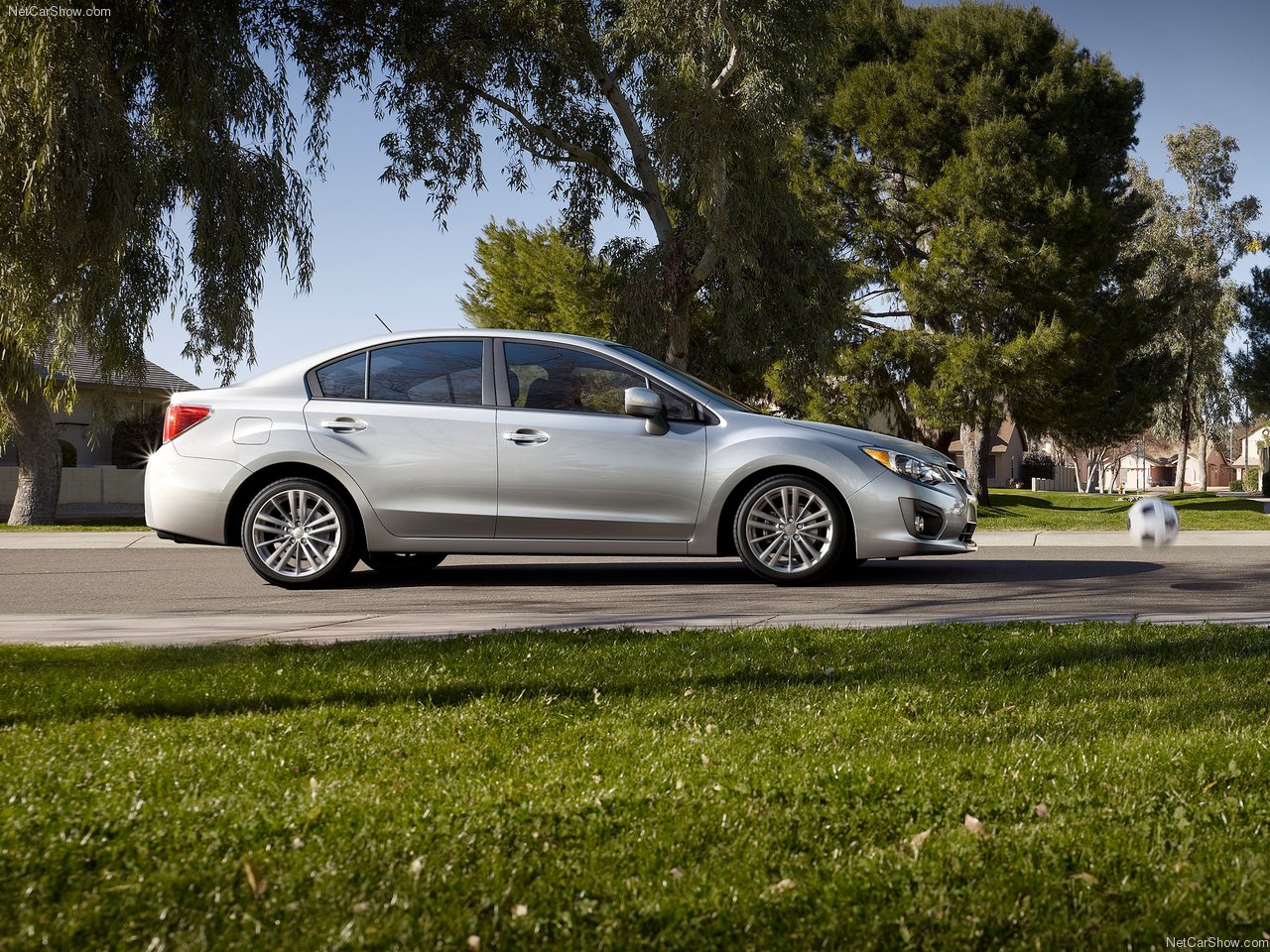
Subaru launched the all-new, fourth-generation 2012 Subaru Impreza model at the 2011 New York International Auto Show. Debuting bolder, more dynamic design and new engines, Subaru's compact contender will also offer increased interior space, refinement and handling agility.

New interior features, infotainment technology and higher grade interior materials promise a more rewarding driving and ownership experience for customers of the 2012 Impreza.

For the UK market, a new 1.6 litre Boxer engine will be teamed with a five-speed manual transmission or the second generation Lineartronic CVT (continuously variable transmission). Every new Subaru Impreza is equipped as standard with Symmetrical All-Wheel Drive, Subaru's invaluable performance and safety enhancing system.

Built on a longer wheelbase but with shorter overhangs, the new Subaru Impreza provides a roomier interior in the same external footprint as the outgoing model. The new passenger cabin not only yields more room, but crucially a greater feeling of spaciousness and better visibility than before.

Bold Design Statement Also Enhances Functionality

The all new Subaru Impreza conveys a bolder, more confident design that emphasises its sporty roots and standard All-Wheel Drive system. In profile, the 2012 Impreza draws focus to its wheels with powerful arches, a theme that debuted on the 2010 Subaru Legacy.
Subaru Impreza (2012)


From the front, the Subaru badge centres the new hexagonal grille, a keystone of all new Subaru designs. The new Impreza sports characteristic Subaru hawk-eye headlights and a range of new 15-inch wheel cover and 16- and 17-inch alloy wheel designs.

Numerous design elements combine to give the Subaru Impreza a sportier exterior stance while also offering the driver and passengers a more commanding view of the road. The windscreen is more raked than in the previous model, with the bottom of the A-pillar moved 7.9 inches forward. This allows for a front door opening that is nearly five inches longer for easier entry/exit, abetted by lower doorsills. Rear doors are also larger on both 4 and 5-door body styles.

Driver visibility has been greatly improved through the use of thinner A-pillars and partitioned front door side glass. Where the door trim meets the window has also been lowered, helping visibility further. The instrument panel is lower and flatter than the outgoing model to give a wider field of view and a feeling of greater spaciousness. New exterior wing mirrors have greater surface area to enhance visibility while relocating them from the A-pillars to the doors contributes to improved sight lines.

Improved Room and Refinement

The new Subaru Impreza's wheelbase grows to 104.1 inches (compared to 103.2 in the outgoing model), while length and width measurements remain the same.

The combination of a longer wheelbase with re-designed interior trim and front seats has led to gains in passenger and cargo room. Rear seat passengers gain nearly two inches of legroom, thanks to both the longer wheelbase and a new, scalloped-style front seat backrest redesign. The 5-door hatchback will benefit from increased luggage space and now provides a completely flat load floor with the standard 60/40 split rear seatbacks folded.

It is now easier to load and unload heavy objects, thanks to the removal of a stepped section under the opening. The cargo area cover can now be stored under the cargo floor, as in the Forester.

Subaru has paid a great deal of attention to improving refinement. Richer looking interior appointments and details abound, including soft-touch materials for the dashboard, door trim and centre console armrest.

Carrying space and utility has been improved throughout; larger door pockets can hold plastic drink bottles and large maps and numerous compartments located in and around the centre console hold all manner of personal items, such as phones, USB drives and MP3 players.

Greater comfort is assured with Subaru Impreza's new front seats with their higher seatbacks, increased lumbar support and cushions that more effectively distribute pressure. As in the 2010 Legacy, the seats are optimized for a rear-end collision. A tilt/telescoping steering wheel is standard on all 2012 Subaru Impreza models.

High levels of standard equipment

Levels of standard equipment have been increased across the range. All models are set to feature electric windows and mirrors, a 60/40-split fold-down rear seat, outside temperature gauge, a multi-function display, engine immobilizer, and tilt/telescopic steering wheel. .

Higher spec models will add more kit including 16 or 17 inch alloy wheels, steering wheel audio and Bluetooth® controls, heated front seats and mirrors, climate control, upgraded instruments and auto lights. Subaru Impreza's new optional navigation system includes a 6.1-inch touch screen LCD display with voice control.

All new gearbox and Boxer engine

UK versions of the Subaru Impreza will be powered by an all new 4-cylinder 1.6 litre Boxer petrol engine and will be available with either a new five-speed manual transmission or Subaru's Lineartronic CVT. With either transmission choice, the 2012 Impreza delivers significantly improved fuel economy over the car it replaces.

Subaru has further refined its CVT so that for the new Subaru Impreza a lighter and more compact unit delivers smooth, linear acceleration, closer to a conventional automatic transmission while still delivering the efficiency benefits of a CVT. Higher specification Subaru Impreza models will feature CVT with a 6-speed manual, operated by steering wheel paddle shifters.

New Subaru Impreza will benefit from improved ride and handling courtesy of strengthened suspension components in front and rear and new hydraulic engine mounts to damp out vibration. The new model keeps its double-wishbone rear suspension which now features new components to improve ride quality and stability. A stiffer body structure, when combined with the new suspension, have also reduced levels of noise, vibration, and harshness (NVH).

Symmetrical All-Wheel Drive: key to Subaru's Brand identity

Subaru will offer two different Symmetrical All-Wheel Drive systems in the new Subaru Impreza. In models equipped with the five-speed manual, the Continuous AWD system uses a viscous-coupling to distribute power 50/50 front to rear, while any slippage will send more power to the opposite set.

Subaru Impreza models equipped with the Lineartronic CVT feature the Active Torque Split AWD version that uses a continuously variable transfer clutch to actively control power distribution in response to driving conditions.

Complementing the safety benefits of the AWD system, the new Subaru Impreza will also come as standard with Subaru's Vehicle Dynamics Control (SVDC) - a system which combines stability and traction control functions - while all models are equipped with ABS, Electronic Brake-force Distribution (EBD) and the Brake Assist safety system.

Subaru's high performance WRX STI, which was launched in Autumn 2011 and is now sold and marketed as a stand-alone model, is not affected in any way by the introduction of a new Subaru Impreza 5-door.

2011 Subaru XV Concept


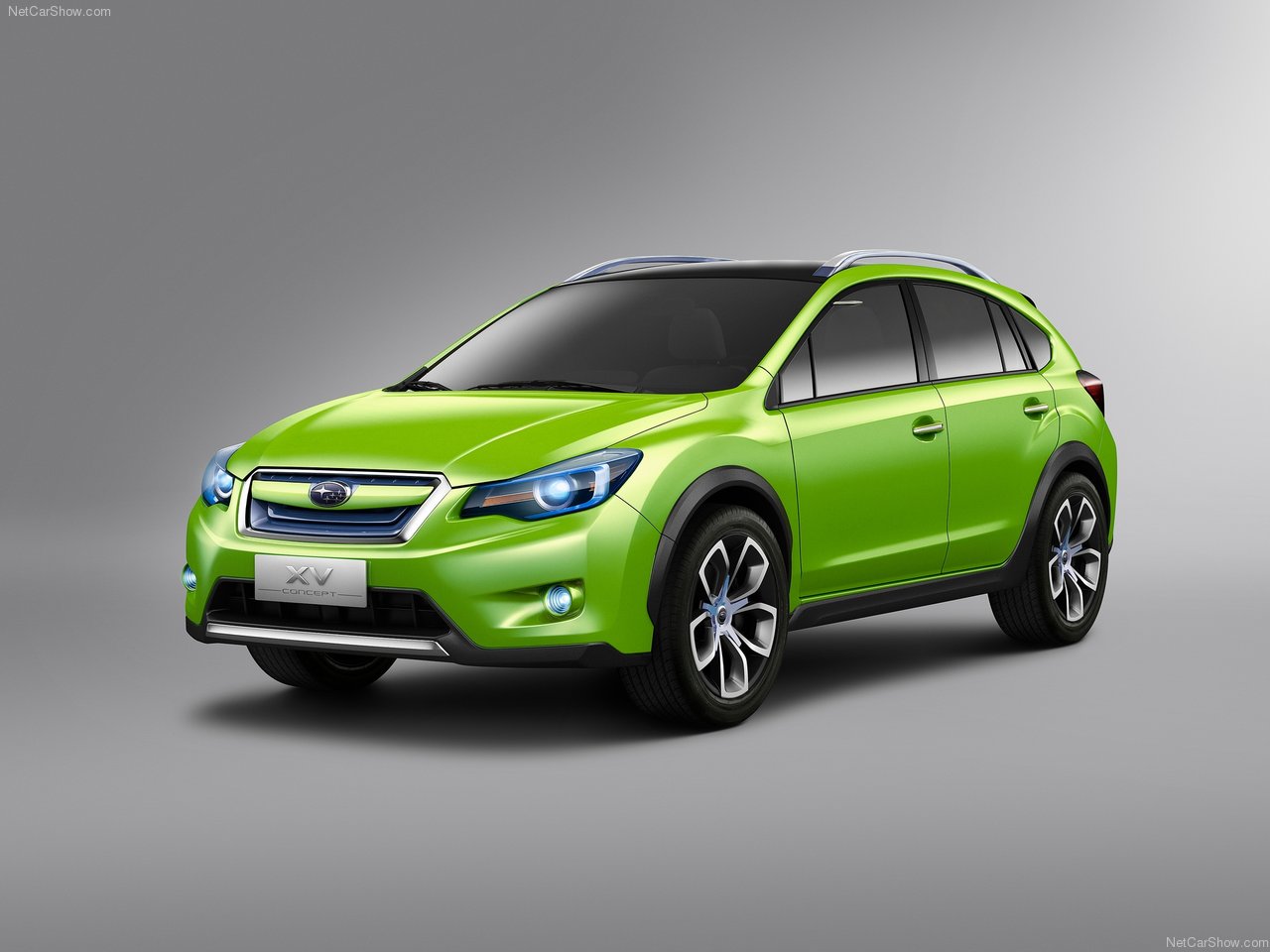
The Subaru XV Concept is Subaru's design concept car that defines a new generation of crossover vehicle, blending exceptional SUV practicality with a fashionable form. The key design concept is "Protren". This word was coined from "Professional tool" and "Trendy design". It expresses the integration of "authentic functionality as a professional tool" and "urban and stylish design".

Exterior Design

The vehicle was engineered to blend the crossover-like commanding silhouette with a fashionable image in a single, modern package. Its contemporary looks and electrifying lines are guaranteed to turn heads, as its body exhibits the very solid, dynamic and independent styling so characteristic of all Subaru's.

At the very front of the vehicle are standard design elements that are common to the Subaru stable, including the hexagon grille, winged motif and sharply- and solidly-designed hawk-eye headlights.

The rear of the vehicle features the same hexagonal design as the front and more hexagons engraved into the clear blue base under the license plate complement the consistent design theme.

To better embody the "Protren" theme, the wheel arch cladding offers the image of functionality, playful touch and driving excitement, which is further enhanced with the black metallic highlights.

The aluminum alloy wheels are designed to combine a solid, intrepid form and a stylish appearance, while at the same time exhibiting a fashionable look suited to urban driving. Contrasting colors - silver spokes, black rims and clear blue center caps - are used intentionally to generate an exciting balance between quality and performance.

The exterior of the vehicle is splashed in riveting "Electro Yellowgreen", resulting in a gleaming tinge seemingly emanating from beneath the matte finish. The color embodies electrifying performance, and above all excitement, to round off a tasteful, and at times potent, package.

Interior Design

"Silvery white leather" is used as the base material for the seats, which firmly envelopes passengers to provide a secure feeling. The use of sporty mesh in selected areas works to create a high quality, yet casual mood, and "yellowgreen" piping gives the interior a sporty and stylish finish.

A large multifunction display sits in the center panel. Three different displays - one each for navigation, car audio, and vehicle information are united in the design and touch panel technology expresses ease of use and can be operated intuitively.

The concept car features Subaru's own advanced driving assist "EyeSight" system. An LCD monitor positioned between the two well-balanced and highly visible combination meters allows the driver to check the images captured with the EyeSight's stereo cameras.

Specifications
Length: 4,450 mm
Width: 1,800 mm
Height: 1,620 mm
Wheelbase: 2,635 mm
Engine: 2.0-liter four cylinder Horizontally-Opposed DOHC engine
Transmission: Lineartronic (CVT)
Tire size: 245/45 ZR19
Passengers: 5

2011 Subaru Outback


Launched in Europe in 1996, the Subaru Outback pioneered the 'Crossover' concept, combining the comfort, interior space and superior on-road handling of a family estate, with the off-road capability and ground clearance of a sports utility vehicle. This special blend of abilities has now been further refined.

The new Subaru Outback is longer, wider and taller than the model it replaces. It is also more capable and more engaging to drive on-and off-road, and offers increased space and comfort for all occupants.

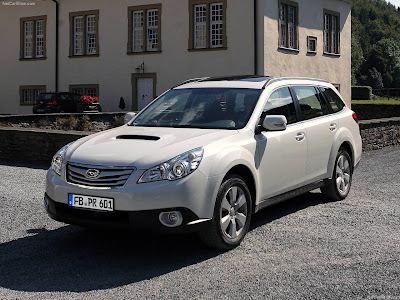
While it retains the bold, assured stance of its forebears, the new Outback boasts a distinctive new 'face'. There's a prominent grille which features Subaru's now-trademark 'wing' motif. This bold detailing, coupled with a pair of ultra-modern, three-dimensional headlamps, gives the go-anywhere vehicle a refined yet purposeful look.

In profile, the Subaru Outback's premium feel continues thanks to muscular, flared wheel arches, standard-fit 17-inch alloys, and a chrome-framed glass-house. Its roofline sweeps towards the rear, where it meets new body-coloured D-pillars.

On the inside, you'll find a sophisticated interior design that perfectly complements the new Subaru Outback's subtly muscular exterior lines. Subaru's design team focused heavily on producing a feeling of spaciousness and quality and, thanks to several improvements such as increased seat adjustability, softer cushioning and reductions in NVH levels, the Subaru Outback's cabin is an even more luxurious and cosseting place in which to travel.
Subaru Outback (2011)


The 1,998cc diesel, which has a six-speed manual gearbox, produces a maximum of 150ps and a top torque figure of 350Nm.

Boasting completely re-engineered suspension and a new all-steel unitary structure, the Subaru Outback's handling and stability have been greatly improved. The presence of the Japanese firm's highly acclaimed AWD system will also reassure buyers that it is sure-footed in all weather conditions.

STYLING AND DESIGN

Clearly inheriting the dynamic 'crossover' styling of its predecessors, but with a bolder and more distinctive silhouette, the new, fourth-generation Subaru Outback projects greater presence, both on- and off-road. The increased length, width, height and wheelbase of the vehicle provided the Subaru design team with an opportunity to give the Subaru Outback a more muscular and expressive design.

The upright front grille, which shares the Subaru family'wing' motif, is placed more prominently and in a higher position, imparting a more robust, taller look to the vehicle. The distinct, three-dimensional shape of the more angular headlamps, with separate, circular fog lamps positioned at both ends of the ample bumper, conveys an increased sense of stability.

The sides of the vehicle are now a more prominent feature of the overall design, thanks to pronounced and muscular new wheel arches that hint at the Subaru Outback's go-anywhere, All-Wheel Drive underpinnings. The edge of the glass-house is framed by chrome-plated mouldings to reinforce a premium-quality feel.

The roofline tapers subtly to the rear, where it meets new, body-coloured D-pillars (in previous-generation Outback the D-pillars were clothed in a black-panel to visually extend the glass-house). This new design feature emphasises the evolution of the exterior design and augments a cohesive sense of solidity.

With the all Subaru Outback, 17-inch alloy wheels are fitted as standard.

More space inside new, high-quality cabin

A sophisticated interior design harmonises with the Subaru Outback's subtly muscular and purposeful exterior lines, and endows the much more spacious cabin with a true sense of quality.

The design team's key mantra was "Active and Quality Feeling", and while exploiting the enhanced cabin space available within the new bodyshell, it concentrated on detailed attention to ensure easy-to-use functionality for the driver and passengers, and maximum comfort for extended journeys. Double-seals on all doors and windows enhance refinement by reducing the intrusion of wind noise.

The all-new, larger front seats offer excellent comfort and support, with 10-way power adjustment on the driver's seat (including lumbar support), and four-way power adjustment on the passenger seat. The front seats feature 20% softer cushions and 10% softer backrests.

The driver's seat benefits from more adjustability, with a 10 mm increase in fore/aft slide range, 20 mm more height movement, a 2 degree increase in cushion tilt and 20 mm lumbar adjustment. Rear-seats passengers are also offered enhanced comfort, with the 60/40 split backrest reclinable over a 20 degree range.

Facing the driver, a new instrument cluster features four dials outlined in aluminium rings, and the new three-spoke steering wheel is leather-wrapped, with integrated audio and cruise controls, and a wider range of adjustment - 40 mm for both reach and rake.

The Subaru Outback comes with leather upholstery as standard.

COMFORT AND CONVENIENCE

The stylish, more spacious and high quality interior of the new Subaru Outback is comprehensively equipped to ensure maximum comfort and convenience for driver and passengers.

Self-levelling suspension, acknowledges the Subaru Outback's long-standing popularity as a load-lugging workhorse or tow car. However hard the car might be working, inside the temperature can be carefully regulated by dual-zone, fully automatic air-conditioning incorporating an anti-dust filter and heating ducts to the rear passenger footwells.

A premium audio system, with a radio / CD player, six speakers (including two tweeters) and steering wheel-mounted remote controls, is standard. For the new Subaru Outback, radio reception has been significantly improved by the fitting of two high-performance antennae within the rear window glass.

The audio systems are MP3-compatible and a Bluetooth hands-free system is fitted. Voice activation from the hands-free microphone allows users to make phone calls and operate the audio appliances.

Facing the new Outback driver, the new instrument panel integrates clarity, functionality and a visual richness in keeping with the premium character of the new model. Four dials are ringed in aluminium and feature an additional liquid crystal display panel in the centre. The dials and the display are illuminated constantly, even in daytime, to improve visibility. The dials appear white with the ignition off and turn light blue with the ignition on.

When the ignition is switched on, the gauge needles sweep to the maximum position and then quickly return to zero - heightening the excitement and anticipation of the journey to come. A glow indicator and diesel particulate filter warning light are added part of the package.

The new Multi-Information Display (MID) is positioned on the centre stack's upper surface so that it can be viewed from all seats. The MID shows ambient temperature, fuel consumption information (instantaneous fuel efficiency, average fuel efficiency and driving range to empty), passenger seatbelt warning lights and a digital clock.

Major controls in the Subaru Outback are laid out to minimise both the intrusion into the driver's line of sight and the time when the driver's hands must be off the steering wheel. Minor controls and switches are positioned to optimise ease-of-use.

The Subaru Outback's comprehensive list of standard equipment also extends to automatic operation of headlamps and windscreen wipers, cruise control, front and rear electric windows (with auto up/down function on the driver's door), a glass 'tilt-n-slide' sunroof, and heated leather seats with memory function.

PRACTICALITY AND STORAGE

The cabin of the Subaru Outback is longer, wider and taller than that of its predecessor, allowing improvements to be made in comfort and practicality. The interior also demonstrates lessons learned in Subaru's latest 'packaging innovation' research programme.

Larger seats are fitted to make best-use of the increased space around each occupant. The space between the front seats has increased by 30 mm and the space between the front and rear seats is increased by 62 mm. The rear seat backrest is split 60/40% and folds flat to offer the best people/cargo carrying versatility. With the rear seats upright, cargo capacity is increased by 67 litres to 526 litres, compared to the previous model.

Larger rear doors result in improved access to the rear seats, and detailed attention to the window shapes and pillar layouts ensures a greater feeling of space and light for the rear seat occupants in the new Subaru Outback.

While the width and height of the luggage bay were increased, the depth of the lip between the rear bumper and cargo was reduced slightly to ensure it is easier for users to load and unload heavy items when lifting them into the interior. The tailgate, which is 33 mm wider and 45 mm taller than before for easier access, features an electromagnetic switch for easy opening with a light touch, aided by twin supporting gas struts.

The new front seats have concave backrests to provide extra knee space for rear seat occupants. The rear seat features a folding centre armrest with twin cup holders, and the backrests can be reclined for greater comfort during long journeys. A remote one-touch mechanism conveniently located in the cargo bay side panel enables the backrests to be folded flat in one simple operation from the rear tailgate when loading long items.

Inside the new Outback designers also paid attention to create generously sized, easy-to-use storage space for smaller items - with capacity increased by 39 litres over the previous model.

The glovebox will accept 31 CDs, while the new double-decker centre console, which can accommodate 22 CDs, incorporates a 12V power supply and AUX audio input socket.

Two cup-holders are provided alongside the centre console, while a 500 ml plastic bottle can be stored in all door pockets. A 50 mm thick box of tissues can also be accommodated in the front door pockets. A central overhead console is provided for storage of sunglasses and small items.

ENGINES

This 1,998 cc diesel is based on the Subaru 'Boxer Diesel' introduced in March 2008 - the world's first horizontally-opposed diesel engine for volume-produced passenger cars. It produces a maximum output of 150 ps and maximum torque of 350 Nm between 1,800 and 2,400 rpm.

For the 2011 Subaru Outback, this unique engine benefits from several technical refinements and enhanced environmentally-friendly features. The shape of the piston crowns has been changed for a wider, shallower design. This, in conjunction with improvements made to gas flow within the combustion chamber, have improved combustion efficiency and reduced the production of particulate matter. A 'lift sensor' has been added to the variable nozzle turbocharger for more precise control of the vanes.

The glow plugs have been changed from a metallic type to a ceramic type, raising the maximum operating temperature and providing better start-up at cold temperatures.

Control of the fuel injection has been optimised and the intake manifold has been redesigned in resin for improved airflow for improved torque characteristics and fuel efficiency. An added benefit of the new resin construction is the 1.5kg weight reduction over the previous aluminium version.

A single exhaust silencer has been used to optimise engine output and noise levels, while also saving weight. The addition of a vibration absorbing structure in the middle of main exhaust pipe also reduces noise levels.

The Subaru Boxer Diesel is fitted with a closed-type diesel particulate filter (DPF) that features a honeycomb shaped filter made of silicon carbide. The DPF, which is positioned low down with the turbocharger to maintain the car's low centre of gravity, improves engine combustion efficiency and reduces particulate matter in the exhaust, further enhancing environmental friendliness.

And finally, the exhaust gas recirculator (EGR) cooler has been enlarged to improve the system's efficiency by 12% - lowering NOx emissions to ensure that the new Outback complies with Euro 5 exhaust gas regulations.

TRANSMISSION

Standard transmission for 2.0-litre diesel model is a new manual six-speed unit. This compact transmission is the same length as the previous five-speed unit and weighs just five kg more.

Improvements featured in the new transmission include a cable-type linkage and a carbon synchronizer for the first and second ratios, constantly-engaged synchromesh for reverse gear, to improve the shift feel, and optimised lubrication paths for reduced friction losses. The broader ratio coverage provided by the six-speed unit delivers better fuel economy, plus improved drivability and quietness at higher speeds.

Full-time 'Symmetrical' AWD - the Subaru hallmark

The Subaru Outback incorporates the latest version of Subaru's Symmetrical AWD (All-Wheel-Drive) system, giving the new model all the traction advantages for which the brand is famous.

This is an evolution of Subaru's original full-time AWD system, which has a well-proven ability to provide real driving pleasure, superior driving performance and long-term reliability.

The four-wheel drive is delivered by a 'Centre differential AWD with viscous LSD' system. This combines a bevel-gear-type centre differential with the basic 50/50% front/rear, torque distribution and a viscous coupling limited slip differential. When a front wheel or rear wheel slips, the viscous coupling raises the torque distribution to other wheels to ensure optimum traction.

For maximum driving safety the Subaru Outback is equipped with Subaru's VDC system. This is an electronic stability control (ESC) programme that closely monitors vehicle behaviour and automatically corrects excessive understeer and oversteer by braking individual wheels and/or reducing engine power, ensuring that the vehicle follows the course intended by the driver for maximum safety.

RUNNING GEAR

Following the strong tradition of the 'Subaru Dynamic Chassis Control Concept', engineers devised and developed the chassis and running gear for the Subaru Outback to feature many new and updated components. Their aim was to create a new Subaru that was exceptionally comfortable and safe to drive for long periods, and over many years of ownership, while also guaranteeing good drivability, high performance and genuine motoring pleasure.

To reduce noise, vibrations and harshness (NVH), and to enhance ride comfort, the engine mounting structure has been entirely renewed, for the first time since the Subaru 1000 model of 1966. An all-new 'Cradle Mount System' was adopted where the engine and transmission are mounted on a sub-frame - rather than directly to the bodyshell. This system brings numerous benefits.

The sub-frame is attached to the bodyshell using rubber bushes, tuned to dampen different frequencies of vibrations generated by the engine, transmission and suspension. For example, the main cushion rubber uses a liquid-filled type of bush, and the engine is supported on the subframe at four widely-spread points.

In addition, the front suspension and the power steering are mounted on the sub-frame, so that potential vibrations from the road surface are not easily transferred to the bodyshell or the car's occupants - improving ride comfort and refinement.

When combined with the AWD drivetrain, the new Outback's 200 mm ground clearance enables the vehicle to tackle rougher ground with ease.

New front and rear suspensions

For the new Outback, Subaru has adopted a revised MacPherson strut front suspension, with the lower arm mounted on the sub-frame for greater stability. Steering response is enhanced, and quietness is increased by reducing vibrations. The thickness of the stabiliser (anti-roll) bar is increased, improving roll stiffness without requiring a change to the main spring rates. Road-holding during cornering is enhanced (thanks in part to a wider track), while smooth ride comfort is retained with extended wheel travel and optimised geometry.

At the rear, new 'short height' compact double-wishbone suspension is used to minimise intrusion into the cabin or cargo space. For maximum refinement, all the suspension links and the rear differential are installed on a new sub-frame. Large bushes are used between the sub-frame and the bodyshell to minimise transfer of NVH.

To achieve an ideal ride/handling balance, new low-friction type front dampers are fitted. At the rear, the Subaru Outback is fitted with specially tuned dampers with a self-leveller function to ensure consistent ride, regardless of payload.

Electric power steering for improved fuel economy

In order to improve both steering feel and fuel economy, a new rack-and-pinion steering system with electric power assistance has been adopted. The system is mounted on the front cradle frame at four points, which increases the rigidity of the steering system, and enhances its initial response to driver inputs. Compared to the outgoing Outback, a quicker ratio is used for more immediate steering response.

New electronic parking brake and hill-hold function

The all-disc braking system, with ABS and EBD (Electronic Brake-force Distribution) as standard, has a linear feel with retardation corresponding closely to applied brake pedal pressure. A redesigned master cylinder gives a 30% faster response to driver inputs on the brake pedal.

Brake Assist is also standard, developing maximum stopping power automatically when the system detects emergency application of the brakes.

For the Subaru Outback, an innovative electronic parking brake is used. Controlled by a dashboard mounted switch, the new system does away with the traditional hand brake, freeing up cabin space and allowing a cleaner, less cluttered centre console design. If the doors are closed and the driver's seatbelt is fastened then the parking brake will automatically release when the driver operates the accelerator pedal.

The new braking system also introduces a 'Hill-Hold' function. When the vehicle is stopped on a slope of 5% or more this feature will hold the vehicle on the brakes for one second after the driver removes their foot from the clutch - long enough to move it to the accelerator without rolling back; a feature that is particularly useful when towing.

Wheels and tyres

The standard wheel and tyre combination on the Subaru Outback is a 17-inch alloy wheel with 225/60 R17 tyre.

STRUCTURE AND SAFETY

As well as 'new-look' styling, larger dimensions and new suspension, the new Outback has a completely reviewed and re-engineered bodyshell. The all-steel unitary structure is revised to enhance ride, handling and refinement, while also delivering the highest level of crash safety performance. The new Subaru Outback's sister model, the new Legacy - with which it shares a chassis and body - was recently awarded a 5-Star Euro NCAP crash safety rating, confirming that Subaru's structural and safety engineers have achieved their targets for this new model.

Newly developed, the bodyshell is both lighter and stiffer, featuring ring-shaped reinforcement frames - 'circular links' - joining the A, B, C and D-pillars with cross members at roof and floor level. This creates a series of 'circular links' which strongly protects the cabin occupants. Ultra-high-strength steel plate (980 Mpa level) is used at key portions of the bodyshell to achieve strength without adding significantly to overall weight.

By fully exploiting the structural characteristics of the newly adopted sub-frame mounting system, the front body structure is redesigned to improve the rigidity of the front suspension installation and to enhance impact resistance as well as steering response. These improvements, and reinforcement of the engine bay bulkhead and toe board areas, were accomplished while also saving 6 kg from the front body panels.

The rear floor structure has also been optimised to accommodate the new sub-frame and to reduce weight while increasing rigidity, further improving rear suspension characteristics and vehicle drivability.

Delivering superior crash safety protection

Using the advanced ring-shaped reinforcements throughout the Subaru Outback bodyshell enhances collision safety and resistance to impacts from all directions. In addition, the newly adopted sub-frame mounting system contributes to an enlarged front-end crush zone, further improving occupant protection.

During a front-end collision, the new front sub-frame deforms in a controlled manner and pushes the power unit to the rear and downwards. As a result, the rearward movement of such a large mass dissipates impact energy and assists the efficient absorption of collision energy by the main body structure.

To enhance side-impact protection, ultra-high-strength steel plate (980 Mpa level) is used for the B-pillar and side sill structures to improve the local cabin area rigidity. In addition, two door impact beams are placed within each front and rear door. By optimally positioning the beams in relation to the door's internal structure, a sufficient crush space is ensured to minimise intrusion. Furthermore, a 'door catcher' is fitted to prevent the bottom of the rear door from deforming into the cabin - particularly in rear impacts.

Despite the relatively short rear overhang, the Subaru Outback's structure is optimised so that rear impact energy is efficiently absorbed by controlled and gradual crushing of the rear sub-frames.

'Passive' safety advances that also benefit pedestrians

While a robust structure can form the foundation for a truly safe car, Subaru has also ensured that the Subaru Outback is comprehensively kitted out with a full range of both 'passive' and 'active' safety equipment - as the best way to prevent occupant injury is to overcome the hazards of daily motoring and avoid any accident in the first place.

The new front seats have significantly-stiffer frames and inner-structures to provide protection against whiplash injuries without having to fit 'active' head restraints. New-design, energy-absorbing head restraints offer greater protection by reducing head impact forces.

Front, side and curtain airbags are fitted as standard. The side and curtain airbags are enlarged for enhanced performance, and the airbag impact sensors have been upgraded to improve responses.

To protect the driver's knee and lower leg, the steering column's structure has been redesigned with an impact-absorption space, and a knee protector is fitted. All the foot pedals and the driver's footrest have a collapsible function (above a pre-set g-force) to reduce the likelihood of foot injuries.

The issue of pedestrian protection has also been addressed. New, impact-absorbing materials and an optimised structure around the front bumper have made it possible for the new Outback to clear the next-generation European pedestrian protection standards, which are the most stringent in the world.

Although steel is used for the hood (to maximise protection of the car's occupants), the impact-absorbing space beneath the hood and above the low boxer engine is enlarged, and the structure is improved around the body cowl to reduce possible injury to a pedestrian.